
EDUCAUSE Annual Conference 2026 · Poster Session Deep Dive

The AI Dean's List: The Full Results

Five AI systems. The same assignment. Thirty-five independently selected priorities. This is the expanded research record behind The AI Dean's List: What Machines Think Higher Ed Tech Needs Next.

The experiment was deliberately simple: give leading AI systems the same open-ended higher-education technology question, keep each system isolated from the others, and compare what they independently identify as important. The interesting part isn't which model was "right." It's where their reasoning converged, where it diverged, and what humans should do with those signals.

Abe Gruber
Presented by
Abe Gruber
VP
LinkedIn
5
AI systems
Independent runs
35
Ranked priorities
Seven per model
10
Normalized themes
For comparison
4
Universal themes
Appeared across all five
0

Start with the Poster

The conference poster is the one-page version of the experiment. Everything on this page expands on that synthesis: the original model reasoning, the methodology behind the comparison, and the implications that did not fit on a 48 × 96-inch poster.

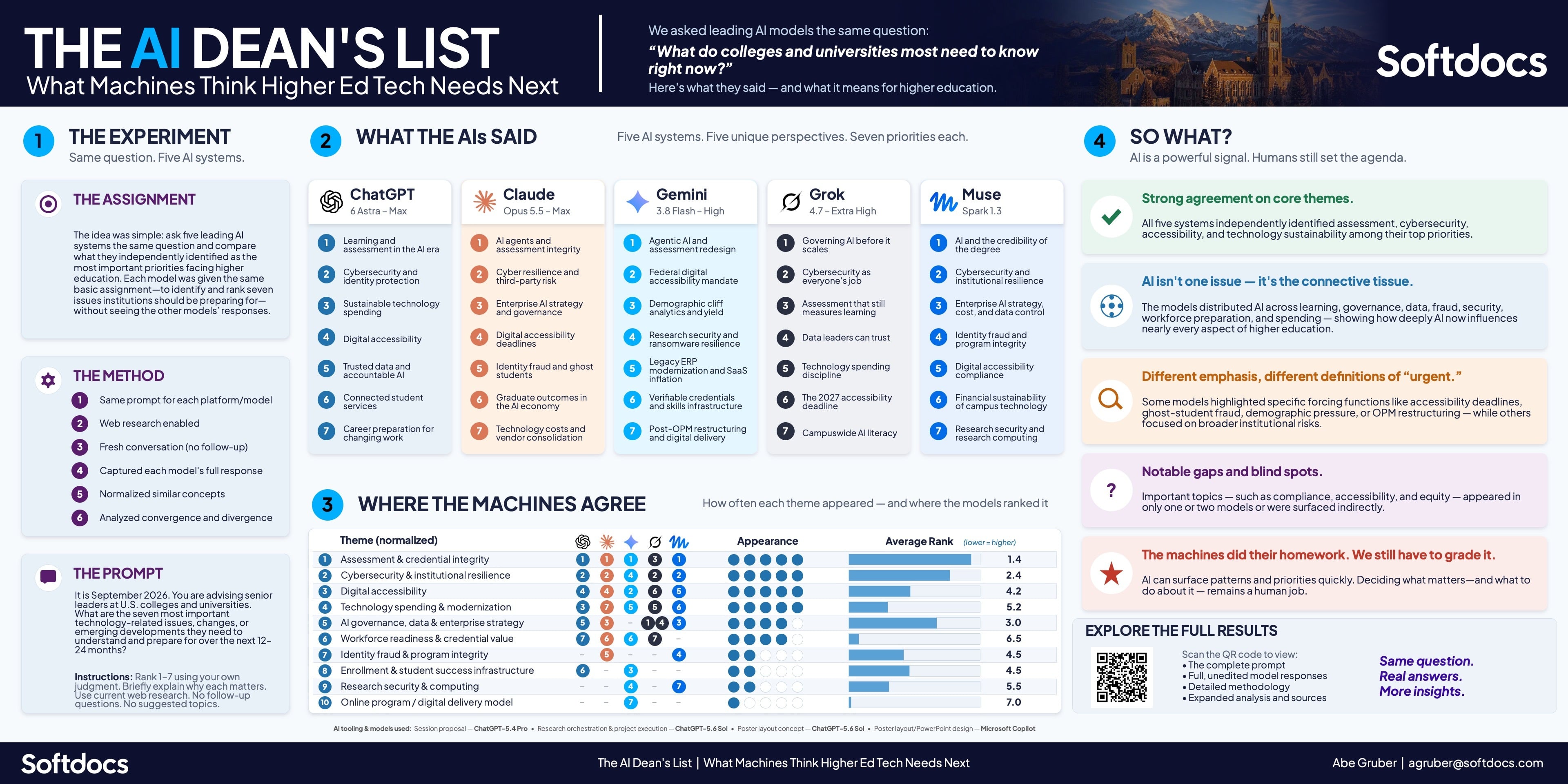
The AI Dean's List EDUCAUSE 2026 poster
Click the poster to open the full-resolution version.

View Full-Resolution Poster →

1

The Experiment

The Assignment

Same question. Five AI systems.

Each model was asked to identify and rank the seven most important technology-related issues, changes, or emerging developments that U.S. colleges and universities should understand and prepare for over the next 12–24 months.

The Constraint

No suggested answers.

The prompt did not prescribe AI, cybersecurity, accessibility, enrollment, ERP modernization, or any other topic. Each system had to decide for itself what belonged on the list.

The Method

01 · Same Prompt
Same core assignment for every system.
02 · Web Research
Current web research enabled.
03 · Fresh Session
No shared context between models.
04 · No Steering
No follow-up prompting after the initial response.
05 · Preserve
Complete responses retained for inspection.
06 · Normalize & Compare
Similar concepts grouped, then convergence and divergence analyzed.
View the complete prompt

THE ASSIGNMENT

It is September 2026. You are advising senior leaders at U.S. colleges and universities. Looking across the higher education landscape, what are the seven most important technology-related issues, changes, or emerging developments that colleges and universities need to understand and prepare for over the next 12–24 months?

Use your own judgment to determine what belongs on the list and rank the seven priorities from most to least important. Do not assume any particular technologies, trends, or issues should be included.

RESEARCH & METHOD

Use web research to inform your analysis and prioritize current information. Research broadly enough to identify important developments rather than simply summarizing the most prominent recent headlines. Favor credible primary sources and authoritative higher-education, government, research, and industry sources where available.

Approach this independently. Do not ask follow-up questions. Do not tailor the answer to any presumed viewpoint, employer, product, vendor, conference, or desired conclusion. Do not attempt to make your answer distinctive from other AI systems; provide the answer you independently judge to be strongest.

Download the complete prompt (.md) →

2

What the AIs Said

The poster shows the seven-item lists. The sections below go further. Each one preserves the model's framing, explains more of the reasoning behind the rankings, and highlights what made that model's answer distinctive.

ChatGPT 6 Astra · Max
Claude Opus 5.5 · Max
Gemini 3.8 Flash · High
Grok 4.7 · Extra High
Muse Spark 1.3
Model 01

ChatGPT

6 Astra · Max
Leadership agenda
1 · Learning and assessment in the AI era
2 · Cybersecurity and identity protection
3 · Sustainable technology spending
4 · Digital accessibility
5 · Trusted data and accountable AI
6 · Connected student services
7 · Career preparation for changing work
Explore ChatGPT's deeper analysis
How it framed the assignment

ChatGPT described its answer as a leadership agenda, not a technology purchasing list. Its ordering considered institutional consequences, breadth of exposure, urgency, and the amount of preparation required between 2026 and 2028.

01 · Learning & assessment

Assessment ranked first because it reaches higher education's core promise: students learn, and credentials reliably represent that learning. The research rejected a simple "AI helps" or "AI harms" conclusion. Instead, it pointed toward assessment redesign that distinguishes genuine understanding from polished AI-assisted output.

02 · Cybersecurity & identity

Ransomware, compromised accounts, fraudulent enrollment, vendor exposure, and recovery capacity were treated as one institutional-resilience problem. Identity protection increasingly crosses admissions, financial aid, academic affairs, payment processes, and traditional cybersecurity.

03 · Sustainable spending

Every other priority competes for the same money, staff, and implementation capacity. Expanding application portfolios, aging systems, staffing shortages, modernization, and new AI investment can collectively overwhelm the institution even when each individual initiative appears rational.

04 · Digital accessibility

Accessibility was framed as an operating discipline covering websites, documents, applications, course materials, procurement, faculty support, and third-party technology—not a one-time remediation project.

05 · Trusted data & accountable AI

As AI moves from answering questions toward recommending and taking actions, unreliable institutional data and unclear authority become larger risks. Better models cannot compensate for poor information, ambiguous decision rights, or weak human accountability.

06 · Connected student services

Fragmented admissions, aid, advising, academic systems, and human support create friction for students and institutions. The underlying argument was that coherent digital service depends on connected information and connected ownership.

07 · Career preparation

AI and automation are altering entry-level work at the same time students and employers are asking for clearer evidence of skills. ChatGPT connected curriculum refresh, work-based learning, AI literacy, and shorter or more verifiable credentials to the broader question of what graduates can demonstrably do.

Its 12–24 month signal: polished submissions will become weaker evidence of a student's own competence. Expect greater use of oral explanation, supervised demonstration, documented revision, disclosed AI assistance, stronger identity controls, tested restoration plans, and closer scrutiny of technology portfolios.

Read ChatGPT's complete unedited response, evidence and sources →

Model 02

Claude

Opus 5.5 · Max
Risk + forcing functions
1 · AI agents and assessment integrity
2 · Cyber resilience and third-party risk
3 · Enterprise AI strategy and governance
4 · Digital accessibility deadlines
5 · Identity fraud and ghost students
6 · Graduate outcomes in the AI economy
7 · Technology costs and vendor consolidation
Explore Claude's deeper analysis
How it framed the assignment

Claude was the most explicit about ranking methodology. It scored priorities against severity, breadth, urgency, and leadership leverage while separating sourced evidence from its own analysis and outlook.

01 · AI agents & assessment integrity

Claude went beyond AI-written essays. It focused on agents capable of navigating learning environments, consuming course material, completing quizzes and assignments, and participating in online courses. The problem shifts from detecting generated text to proving that the enrolled student actually performed the intellectual work.

02 · Cyber resilience & third parties

Faster exploitation, AI-assisted attacks, and concentrated vendor risk broaden cybersecurity from prevention toward institutional resilience. A compromise at one major provider can affect many campuses simultaneously, making recovery and supplier dependency strategic concerns.

03 · Enterprise AI governance

AI purchasing is moving faster than many institutions can establish strategy, data rules, ownership, or measures of value. Claude treated today's platform and contract decisions as choices that can lock in future cost, risk, data access, and vendor dependency.

04 · Accessibility deadlines

Accessibility ranked highly because remediation is time-bound, distributed, and slow. Websites, applications, documents, course materials, and third-party platforms can create a large remediation inventory that cannot realistically be solved at the last minute.

05 · Ghost students & identity fraud

Fraudulent enrollment was treated as a distinct higher-education operating risk. AI-generated identities and automated enrollment connect financial aid, admissions, student verification, and institutional workload—especially for online and open-access institutions.

06 · Graduate outcomes

Weak entry-level hiring, student concerns about AI, and greater attention to graduate earnings create pressure for curricula and career preparation to change faster than traditional academic governance usually allows.

07 · Costs & vendor consolidation

Supplier consolidation, bundled AI capabilities, rising software costs, and switching friction can turn routine renewals into strategic constraints. Claude emphasized portfolio discipline and credible exit options so existing commitments do not crowd out future priorities.

Its 12–24 month signal: assessment and identity assurance begin to collide. Claude anticipated more supervised, oral and process-based assessment, greater attention to student identity and academic engagement, more explicit third-party cyber planning, and increasing pressure to govern AI procurement before platforms become difficult to unwind.

Read Claude's complete unedited response, evidence and sources →

Model 03

Gemini

3.8 Flash · High
External pressure + modernization
1 · Agentic AI and assessment redesign
2 · Federal digital accessibility mandate
3 · Demographic cliff analytics and yield
4 · Research security and ransomware resilience
5 · Legacy ERP modernization and SaaS inflation
6 · Verifiable credentials and skills infrastructure
7 · Post-OPM restructuring and digital delivery
Explore Gemini's deeper analysis
How it framed the assignment

Gemini produced the most concrete forcing-function-oriented list. Its priorities repeatedly tied technology decisions to external deadlines, demographic change, research requirements, vendor economics, workforce signaling, and structural changes in online-program delivery.

01 · Agentic AI & assessment redesign

Gemini argued that higher education has moved beyond simple chatbots toward systems capable of multi-step planning, synthesis, coding, and autonomous work. Traditional artifacts of learning—essays, unproctored quizzes, basic coding exercises, and discussion posts—therefore provide weaker evidence of individual mastery.

02 · Accessibility mandate

Accessibility ranked second because Gemini treated the federal timetable as a hard forcing event. Institutions must address not only their own web properties but learning materials, third-party platforms, and the accumulated volume of digital content requiring remediation.

03 · Demographic cliff & yield

Demographic contraction was tied directly to recruitment technology, CRM, predictive analytics, retention, and yield. In this framing, enrollment technology becomes infrastructure for preserving institutional financial viability as traditional applicant pools become harder to replace.

04 · Research security & ransomware

Gemini combined operational resilience with growing security expectations around federally sponsored research. For research universities, weak controls can threaten not only systems and data but strategically important research relationships and funding.

05 · ERP modernization & SaaS inflation

Aging ERP and SIS environments combine with rising cloud software costs to create a difficult modernization equation. Legacy complexity makes change expensive, while moving to SaaS does not automatically make the underlying economics better.

06 · Verifiable credentials

Public skepticism about degree value led Gemini toward portable, machine-verifiable and skills-oriented credentials that communicate learning more directly to employers and workforce systems.

07 · Post-OPM digital delivery

Changes in online-program economics and regulation may require universities to own more of their digital delivery, recruitment, student experience, and supporting technology rather than relying heavily on external partners.

Its 12–24 month signal: external events may force decisions faster than normal institutional planning cycles. Accessibility deadlines, enrollment pressure, research requirements, software economics, and changes in online-program delivery all make postponement increasingly costly.

Read Gemini's complete unedited response, evidence and sources →

Model 04

Grok

4.7 · Extra High
Governance + operating model
1 · Governing AI before it scales
2 · Cybersecurity as everyone's job
3 · Assessment that still measures learning
4 · Data leaders can trust
5 · Technology spending discipline
6 · The 2027 accessibility deadline
7 · Campuswide AI literacy
Explore Grok's deeper analysis
How it framed the assignment

Grok was the only system to put enterprise AI governance first. Its premise was that AI is already embedded in daily institutional behavior while strategy and oversight lag behind.

01 · Governing AI before it scales

Grok highlighted the gap between frequent individual AI use and much lower prevalence of centralized institutional strategy. Its concern was that decentralized experimentation becomes embedded workflow before institutions establish rules for data, procurement, accountability, teaching, or risk.

02 · Cybersecurity as everyone's job

Security was framed as an institutional behavior problem rather than purely a specialist function. AI, vendors, identity threats, and distributed technology make security habits and risk ownership across campus part of the defense.

03 · Assessment that measures learning

Grok arrived at the same underlying assessment problem as several other systems but ranked governance and cyber risk above it. Finished products are becoming weaker evidence of individual learning, increasing the importance of process and demonstrated capability.

04 · Data leaders can trust

Useful AI, privacy compliance, financial analysis, and student decisions depend on governed information. Fragmented systems and unclear ownership therefore become both operational constraints and AI risks.

05 · Technology spending discipline

Rising costs, uncertain AI returns, and technical debt mean institutions increasingly need to decide not only what to buy, but what to consolidate, modernize, or stop.

06 · Accessibility deadline

Accessibility was treated as an immediate planning obligation. The remaining implementation window is useful only if institutions use it to remediate and redesign rather than interpreting it as time to defer.

07 · Campuswide AI literacy

Students, faculty, and staff already use AI, but use without shared standards or discipline-specific judgment creates uneven quality and risk. AI literacy therefore becomes part workforce capability, part academic skill, and part institutional control.

Its 12–24 month signal: the governance gap becomes harder to close as AI moves out of isolated chat windows and into institutional workflows. Strategy, data governance, cybersecurity, procurement, literacy, and assessment increasingly become one interconnected operating-model problem.

Read Grok's complete unedited response, evidence and sources →

Model 05

Muse

Spark 1.3
Credibility + sustainability
1 · AI and the credibility of the degree
2 · Cybersecurity and institutional resilience
3 · Enterprise AI strategy, cost and data control
4 · Identity fraud and program integrity
5 · Digital accessibility compliance
6 · Financial sustainability of campus technology
7 · Research security and research computing
Explore Muse's deeper analysis
How it framed the assignment

Muse's list centered on institutional credibility and sustainability: can colleges continue to demonstrate legitimate learning, protect the institution from disruption, retain control of sensitive data, and afford the increasingly complex technology environment required to do all three?

01 · Credibility of the degree

Muse placed the meaning of the degree first. High levels of AI use, combined with weakening confidence in AI detection, led it toward the conclusion that institutions need assessment built around evidence of thinking and capability rather than enforcement alone.

02 · Cybersecurity & resilience

Ransomware and cyber exposure were treated as continuity risks occurring while budget constraints can simultaneously weaken defense. Resilience therefore depends on both technical controls and the institution's ability to maintain expertise and recovery capability.

03 · AI strategy, cost & data control

Muse focused on who will control the campus AI layer. Major vendors are competing to embed AI throughout institutional work, forcing leaders to decide what to buy, build and govern—and what happens to student and research data once those platforms become deeply embedded.

04 · Identity fraud & program integrity

Bot-driven ghost-student schemes make identity a program-integrity issue spanning federal aid, admissions, online learning, and student verification. AI can transform what once looked like isolated fraud into a scalable institutional process problem.

05 · Accessibility compliance

Institutions remain responsible for accessibility even when platforms and content come from third parties. Procurement, vendor governance, and content ownership therefore become central parts of the accessibility response.

06 · Financial sustainability

Expensive modernization, limited IT staffing, and enrollment pressure led Muse to frame technology as a financial-sustainability issue, particularly for tuition-dependent institutions. The relevant question becomes what operating model the institution can sustainably support.

07 · Research security & computing

Security requirements, research-compliance obligations, funding uncertainty, and growing computing demands are colliding. Research infrastructure consequently becomes both a technology concern and a condition of institutional research capacity.

Its 12–24 month signal: assessment redesign accelerates while major platform decisions create longer-lived questions about cost and data control. Muse's distinctive contribution was tying academic credibility, resilience, and financial sustainability together.

Read Muse's complete unedited response, evidence and sources →

3

Where the Machines Agree

The wording differed substantially, so comparison required looking past individual titles. Closely related ideas were grouped into normalized themes while preserving meaningful distinctions between them.

5 of 5 models

Assessment & Credential Integrity

Average rank: 1.4

5 of 5 models

Cybersecurity & Resilience

Average rank: 2.4

5 of 5 models

Digital Accessibility

Average rank: 4.2

5 of 5 models

Technology Spending & Modernization

Average rank: 5.2

The strongest signal

The most consistent result was not a particular product or emerging technology. It was that AI is forcing institutions to revisit the meaning of learning, identity, trust, governance, and technology sustainability at the same time.

The Full Normalized View

Theme Pattern Interpretation
Assessment & credential integrity 5/5 · Avg. 1.4 The clearest point of convergence and generally the highest-ranked issue.
Cybersecurity & institutional resilience 5/5 · Avg. 2.4 Consistent agreement that cyber risk is institutional rather than merely technical.
Digital accessibility 5/5 · Avg. 4.2 Universal inclusion, with some models emphasizing specific deadlines more strongly.
Technology spending & modernization 5/5 · Avg. 5.2 Different language, same pressure: cost, modernization, staffing, and portfolio discipline.
AI governance, data & enterprise strategy 4/5 · Avg. 3.0 A major recurring theme framed variously as governance, trusted data, or enterprise control.
Workforce readiness & credential value 3/5 · Avg. 6.5 AI's labor-market impact appeared more selectively than its academic impact.
Identity fraud & program integrity 2/5 · Avg. 4.5 Narrower consensus, but strongly emphasized where included.
Enrollment & student-success infrastructure 2/5 · Avg. 4.5 Connected services and demographic pressure surfaced through different lenses.
Research security & computing 2/5 · Avg. 5.5 Important but institution-type dependent, particularly for research universities.
Online program & digital delivery model 1/5 · Avg. 7.0 A specific market and operating-model issue rather than broad consensus.
4

So What?

AI is a powerful signal. Humans still set the agenda.

✓

Strong agreement on core themes.

All five systems independently identified assessment, cybersecurity, accessibility, and technology sustainability among their top priorities. Different language did not hide the underlying convergence.

◎

AI isn't one issue—it's the connective tissue.

The models spread AI across learning, governance, data, security, fraud, workforce readiness, and spending. AI increasingly behaves like a horizontal institutional layer rather than a single technology initiative.

⌕

Different definitions of "urgent."

Some systems emphasized durable institutional problems. Others elevated forcing functions—deadlines, demographic shifts, fraud, research requirements, vendor economics, or changes in digital delivery.

?

The disagreement is useful too.

A topic appearing once is not automatically unimportant. Divergence can reveal different research paths, category boundaries, or genuinely unsettled questions. Frequency is a signal—not proof.

≠

Normalization is itself a human act.

"Ghost students," "identity fraud," "program integrity," and "identity protection" overlap without being identical. Comparison requires judgment. The source responses therefore remain part of the record.

★

The machines did their homework. We still have to grade it.

AI can scan a landscape, surface recurring patterns, and identify outliers quickly. Institutional context still determines what matters, what tradeoffs are acceptable, and what leaders should actually do.

5

What This Experiment Does—and Doesn't—Tell Us

This is a structured AI-assisted environmental scan, not a scientific survey of higher education priorities. The distinction matters.

Caveat 01

Small sample

Five systems reveal patterns, but they do not represent every model or configuration.

Caveat 02

Time-sensitive

These answers reflect September 2026 models, sources, search results, and conditions.

Caveat 03

Research isn't completeness

Web-enabled systems still decide what to retrieve, emphasize, combine, or omit.

Caveat 04

Normalization adds judgment

Reasonable analysts could draw some thematic boundaries differently.

Caveat 05

Agreement isn't validation

Models can converge on a real signal—or share similar assumptions, sources, and blind spots.

Questions worth asking next

  • Which issues did every model see that institutions may still be underweighting?
  • Which one-off issues deserve more attention rather than less?
  • What important issue did all five miss?
  • Which "new" themes are actually longstanding challenges in a new form?
  • How much of the consensus reflects the current higher-education information environment?
  • Would the list look materially different six months from now?
  • What changes when human higher-education leaders rank the same issues?
6

Explore the Full Research Record

The synthesis should be inspectable against the underlying work. These files are intentionally preserved as close as practical to the original AI conversations instead of being rewritten into one retrospective narrative.

The Five Model Responses

How the Session Was Built

7

AI Studying AI

There is a second experiment embedded inside the first one: AI was not only the subject of the session. It was also part of the workflow used to create it.

Step 1
Human Question
Step 2
AI-Assisted Research Design
Step 3
Independent Model Research
Step 4
Human Normalization & Judgment
Step 5
AI-Assisted Synthesis
Step 6
Human Communication
The obvious question

What did the AI say?

The more interesting question

Where in this process should machines contribute—and where is human judgment indispensable?

Continue the Conversation

What did the machines miss?

If you attended the session, I'd be interested in what stood out: an area of surprising agreement, something one model caught that the others missed, or a major issue you think all five overlooked.

Abe Gruber
Abe Gruber
VP

AI tooling used in the project: Session proposal — ChatGPT-5.4 Pro · Research orchestration & project execution — ChatGPT-5.6 Sol · Poster layout concept — ChatGPT-5.6 Sol · Poster layout / PowerPoint design — Microsoft Copilot · Companion web page design & development — ChatGPT-5.6 Sol.

Research conducted September 2026. AI products, model names, capabilities, web-search behavior, and available information may change over time.